
The IPO Cycle: When Long-Term Investors Should Actually Buy New Stocks
IPOs are exciting.
A new company hits the market, financial media lights up, growth stories spread quickly, and investors start imagining they are getting access to the next massive winner at the beginning of the journey.
Sometimes they are. But often they are buying at the wrong time.
The Hidden Problem With IPOs
A simple truth gets ignored during IPO excitement:
Companies usually go public when conditions are favorable for them, not necessarily for outside investors. That means valuations are often rich, sentiment is strong, and expectations are elevated from day one. For traders, that can create opportunities. For long-term investors, it often creates risk.
Because when excitement fades, price has to reconnect with fundamentals.
The Typical IPO Pattern
A lot of newly public companies follow a similar pattern:
First comes the hype phase.
Then comes the come-down phase.
Then comes a long period of range-bound trading or stagnation.
Only later, if the business truly executes, do fundamentals catch up and drive a better long-term entry or a real breakout.
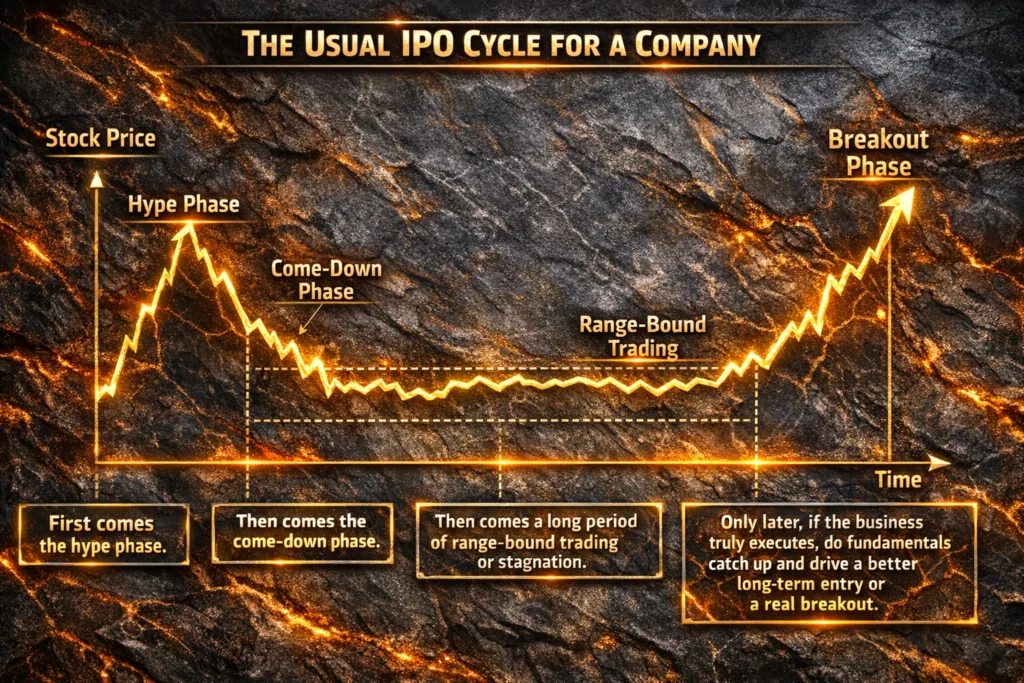
That is the IPO cycle.
And it is far more common than many investors realize.
Why the Best Time to Buy Is Often Later
Examples like SoFi, Hims, Palantir, and Dutch Bros show this pattern. These companies often attracted attention near the listing, disappointed or went sideways for long stretches, and only later became much stronger investments once the underlying business improved enough to justify the valuation.
That is the big lesson:
The best long-term buy is often not at the IPO.
It is during the consolidation period that follows.
Ignore the Hype, Build the Watchlist
A better framework for long-term investors is simple:
Do not feel pressure to buy the IPO.
Do not confuse excitement with value.
Do put the company on your watchlist.
Do follow the business.
Do wait for the market to settle and the fundamentals to prove themselves.
This approach turns IPOs from hype events into future opportunity sets.
Instead of asking, “Should I buy this right now because it is new?” ask:
“Could this be a much better stock two or three years from now?”
That is often the smarter question.
Why Consolidation Can Be the Opportunity
Once an IPO has been public for a while, something important happens. There is more evidence.
You can study margins, execution, guidance credibility, conference calls, customer traction, and valuation with far more clarity. The market has usually lost some of its euphoria, and the business has had time to either prove itself or disappoint.
That creates a much better environment for long-term decision-making. In many cases, the real money is made not by buying the IPO itself, but by building conviction during the boring period that follows it.
The Real Advantage
The IPO cycle matters because it helps investors avoid a common trap: paying peak enthusiasm prices for incomplete proof.
It also helps build patience. Some of the companies going public today may become outstanding buys later. But that usually requires time, better execution, lower hype, and a more favorable risk/reward setup. Long-term investors benefit from letting that process play out.
Final Thoughts
The IPO cycle is one of the most useful mental models for long-term stock investors.
New listings are often most exciting near the beginning, and most attractive later.
So the smarter play is usually not:
buy the hype.
It is:
watch closely, let the story mature, wait for fundamentals to catch up, and buy when the business is stronger and the setup is better.
That is how long-term investors turn excitement into discipline, and discipline into better returns.