

Why Your Investing Knowledge Must Grow With Your Portfolio
A small portfolio can survive a few mistakes.
A large portfolio cannot.
That is why one of the most underrated truths in investing is this: your knowledge has to grow with your portfolio.
In the early stages, many investors have a small amount of money and a lot to learn. That is normal. In fact, it can be an advantage. Smaller portfolios give you room to make minor mistakes, refine your process, and build skill before every decision becomes financially heavy.
But over time, the stakes change.
A choice that barely matters in a $10,000 portfolio can matter a lot in a $300,000 or $700,000 portfolio. That is why competence cannot stay flat while capital rises.
Why the First Few Years Matter So Much
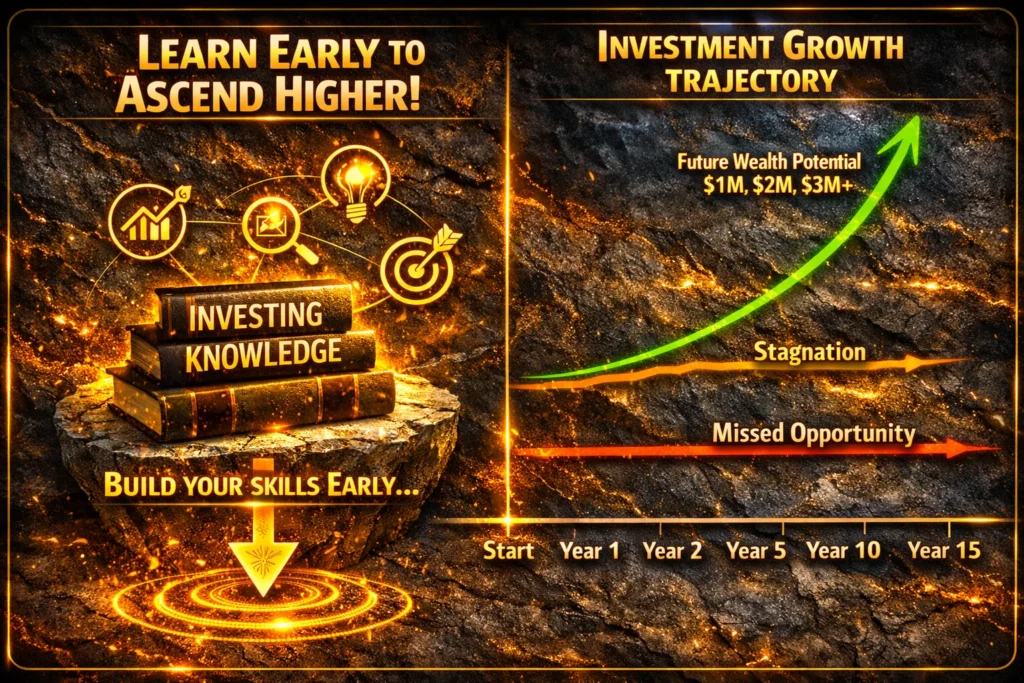
One of the strongest ideas is that investors should try to learn a huge portion of the core skill set early. Not because learning ever ends, but because the first few years set the trajectory.
If you spend those years learning quickly, making smaller mistakes, and building a solid framework, you give yourself a chance to compound with real confidence later.
If you learn too slowly, the opposite happens. Mistakes multiply. Bad habits harden. And by the time the portfolio becomes meaningful, your process may still be weak.
That is a dangerous mismatch.
The Problem With Big Money and Small Knowledge
Some investors gradually build wealth inside the portfolio.
Others arrive with significant capital from a business, inheritance, real estate, or savings. On paper, that sounds great. In practice, it can be risky.
Why?
Because large capital plus low competence creates pressure. Every decision becomes more important before the investor has really earned conviction. That can lead to oversized mistakes, emotional decisions, and expensive experimentation. That is why knowledge should ideally scale alongside portfolio size. When the portfolio grows with your skill, confidence tends to be healthier and more grounded.
What Should Investors Learn First?
A smart investing education is not random. It helps to think of it like a skill tree.
The most important areas include:
- portfolio management
- position sizing
- diversification
- balance sheet analysis
- income statement analysis
- cash flow analysis
- valuation frameworks
- reading 10-Ks
- understanding management quality
- building projections
- emotional discipline and long-term mindset
This is why serious investors improve faster when they follow a structure instead of just bouncing between stock picks, headlines, and social media opinions.
Grow Your Skill at the Same Pace as Your Capital
The ideal scenario is simple:
As your money grows, your judgment improves.
As position sizes grow, your process gets sharper.
As responsibility increases, your confidence becomes more evidence-based.
That is a much healthier curve than having capital far ahead of competence.
And if you already have a meaningful amount of money but still feel early in your investing journey, the solution is not panic. The solution is structure. You may simply need to move more gradually, phase capital in, and compress the learning curve so your process catches up.
Final Thoughts
Your portfolio is not just growing in dollars. It is growing in responsibility.
That is why investing knowledge must grow with your portfolio. A larger account should be backed by better judgment, better valuation work, better research habits, and better emotional control.
The best time to build that skill is early. Because once the portfolio becomes real money, every decision becomes real too.
To accelerate your progress, apply to become member for serious investors -> apply for Private Group.